MVPs
How Much Does an MVP Cost in 2026? Real Price Ranges
 Akshit Ahuja9 min read
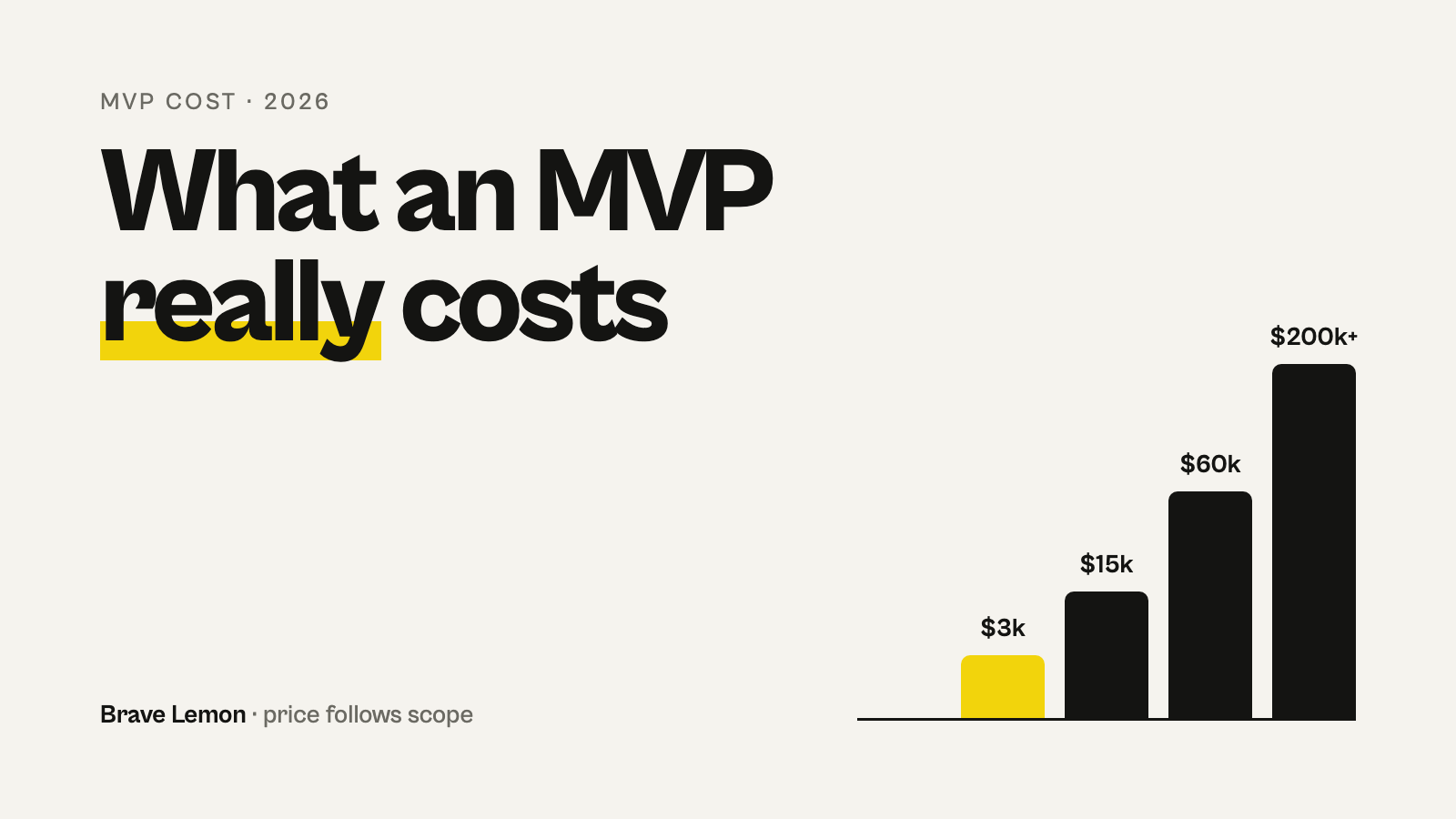
A focused MVP with one core feature, login and an admin panel costs about $3,000 to $15,000 in 2026. A standard MVP from a freelance team runs $15,000 to $60,000, and an agency build usually starts near $50,000. Scope sets the price more than anything: extra user types, native apps and compliance each add 20 to 100%.
Last updated 22 November 2026. Every price below was checked on its source page that day.
Key takeaways
- "MVP" covers everything from a no-code test to a $200,000 agency build, which is why published ranges look random. Compare quotes for the same scope, never for the word.
- Neutral data puts most software companies at $24 to $49 an hour, with US firms at $50 to $99 (Clutch, September 2026).
- Hiring in-house is the priciest route for a first build: the median US software developer earns $135,980 a year (BLS, May 2025).
- Budget for life after launch too: hosting, app store fees and a 20 to 30% buffer for fixes.
- Disclosure: Brave Lemon builds MVPs from $3,000. Our price is in the tables, and we say plainly where it does not fit.
This guide is for first-time founders pricing a software MVP: a web app or mobile app. It does not cover hardware products, Shopify stores or the cost of running a team after launch.
In this guide
- What does an MVP cost by type?
- What does neutral data say about development prices?
- How much does the same MVP cost from different builders?
- What makes an MVP quote go up?
- What costs do founders forget?
- What does a $3,000 MVP actually include?
- Who should spend more, and who should spend less?
- How do you get an MVP quote you can trust?
- FAQ
What does an MVP cost by type?
An MVP costs between nothing and $200,000+, and the type of MVP explains almost all of that spread. A minimum viable product is the smallest version of your idea that real users can try and pay for. For one founder that is a no-code app built over a few weekends. For another it is a web app with payments, three user roles and an admin dashboard.
Here is the ladder, from cheapest to most expensive, with each number taken from the source named in the last column.
| MVP type | What you usually get | Typical cost | Typical time | Source |
|---|---|---|---|---|
| No-code, built by you | One workflow on Bubble or a similar tool | $0 to $8,000, plus $32 to $119 a month for the platform | A few weeks | StartupHub.ai; Bubble pricing page |
| Focused build | One core feature, login, database, admin panel | $3,000 to $15,000 | 2 to 4 weeks | Inigra (GBP 5,000 to 10,000 in 2 to 4 weeks); StartupHub.ai ($2,000 to $15,000); Brave Lemon (from $3,000) |
| Standard MVP, freelance team or small studio | 3 to 5 features, custom design | $15,000 to $60,000 | 1 to 3 months | StartupHub.ai; Inigra (GBP 10,000 to 20,000) |
| Agency MVP | Discovery, design, build, QA, launch | $50,000 to $200,000+ | 2 to 5 months | StartupHub.ai; Altar.io (EUR 40,000 to 160,000) |
| Complex or regulated | Health, finance or enterprise rules | EUR 200,000+ | 5+ months | Altar.io |
Two things stand out. First, the ranges overlap, because a small studio and a large agency can build the same product at very different prices. Second, almost every price guide you will find is written by an agency pricing its own work, including this one. That is why the next section uses data from sources that sell no development at all.
What does neutral data say about development prices?
Clutch and the US Bureau of Labor Statistics are the two best neutral anchors, because neither sells development. Clutch collects pricing from first-party reviews submitted by verified clients of software companies. Its 2026 pricing guide, updated 21 September 2026, reports:
| Clutch figure (2026) | Value |
|---|---|
| Hourly rate most software companies charge | $24 to $49 |
| Typical range of reviewed projects | $10,000 to $49,000 |
| Average reviewed project | $132,480 over about 13 months |
| Average hourly rate, United States firms | $50 to $99 |
| Average hourly rate, India firms | $25 to $49 |
| Average hourly rate, Canada and Australia firms | $100 to $149 |
Read the $132,480 average with care. It covers full software projects that ran for about a year, not MVPs. The more useful line for a founder is the typical range: most reviewed projects landed between $10,000 and $49,000.
The BLS gives the in-house side. The median annual wage for software developers was $135,980 in May 2025. The lowest 10% earned under $82,460 and the top 10% over $214,670. That is salary only, before benefits, equipment and the weeks it takes to hire.
How much does the same MVP cost from different builders?
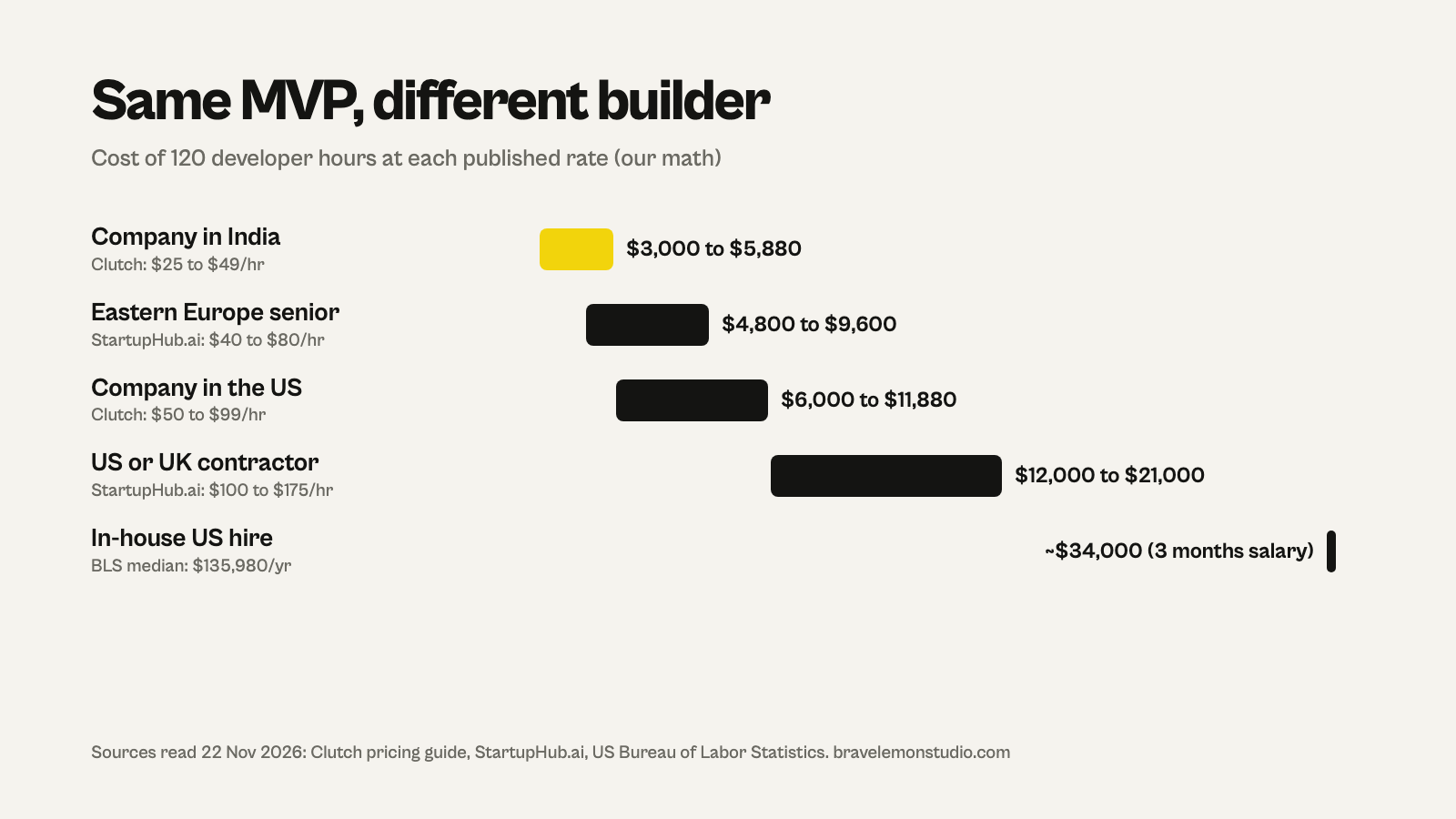
The same scope can cost four times as much depending on who builds it, because hourly rates vary that widely. To make this concrete, take a focused MVP that needs about 120 hours of developer time, roughly three weeks of full-time work. The table multiplies those hours by each published rate. The arithmetic is ours; the rates are from the sources named.
| Who builds it | Published hourly rate | Cost of 120 hours (our math) |
|---|---|---|
| Software company in India | $25 to $49 (Clutch) | $3,000 to $5,880 |
| Software company in the US | $50 to $99 (Clutch) | $6,000 to $11,880 |
| Senior engineer in Eastern Europe | $40 to $80 (StartupHub.ai) | $4,800 to $9,600 |
| US or UK contractor | $100 to $175 (StartupHub.ai) | $12,000 to $21,000 |
| Company in Canada or Australia | $100 to $149 (Clutch) | $12,000 to $17,880 |
| In-house US developer | $135,980 a year median (BLS) | About $34,000 for three months of salary alone |
A cheaper rate is only cheaper if the work ships. StartupHub.ai says freelancers typically produce equivalent quality at 40 to 60% of agency cost. In our experience the catch is coordination: with separate freelancers for design and code, the founder becomes the project manager. The deciding question is whether you can run the build yourself, or want one party accountable for it.
What makes an MVP quote go up?
Every feature you add multiplies the work behind it, so a few choices drive most of the price. Inigra, a Polish software house that says it has shipped 30+ MVPs, publishes how much each one adds to a base build:
| Choice | Typical cost increase |
|---|---|
| Multiple user types (for example buyers and sellers) | +30 to 50% |
| Real-time features (chat, live updates) | +20 to 40% |
| Each third-party integration | +10 to 30% |
| Custom design instead of a template | +15 to 25% |
| Regulatory compliance | +20 to 40% |
| Native iOS and Android apps | +50 to 100% |
Altar.io, an MVP agency, puts compliance higher at 25 to 40% of the build cost. The cheapest MVP is the one with one user type, one core workflow, a web app instead of native apps, and no integrations beyond login and payments. You can add the rest once users prove they want it.
What costs do founders forget?
The build quote is not the full bill. Running a live product costs money every month, and the first weeks after launch always turn up fixes. These are the costs to plan for, with prices from each vendor's own pricing page:
| Cost | Price | Source |
|---|---|---|
| Web hosting | $20 a month (Pro plan) | Vercel |
| Database and auth | From $25 a month (Pro plan) | Supabase |
| No-code platform, if you go that way | $32 or $119 a month, billed annually | Bubble |
| Apple App Store account | $99 a year | Apple Developer Program |
| Google Play account | $25 one time | Google Play Console |
| Post-launch fixes and changes | Add a 20 to 30% buffer | Inigra |
Many MVPs run on free tiers for the first months, so these are ceilings for an early product, not a fixed monthly bill. The buffer matters more: real users always find something the plan missed.
What does a $3,000 MVP actually include?
A $3,000 MVP buys one thing done properly, not a smaller version of everything. This is our own offer, so read it as one data point, not a market rate. Brave Lemon's MVP Sprint starts at $3,000 and takes about three weeks. It includes:
- One core feature, the one your users would pay for
- Login, a database and an admin panel to manage it
- Launch on your own accounts, with the code yours from signing
- A fixed price and written scope before work starts, 50% upfront and 50% at launch
- Two weeks of fixes after launch
It does not include native mobile apps, several user types with separate dashboards, or regulated data. Those choices sit in the higher rows of the tables above, and we would quote them separately before any work starts. We price this low because a small team with no account managers can, and because we have built and run our own products, including Peerseek and Folio.
Who should spend more, and who should spend less?
Spend at the low end if you are testing whether anyone wants the product. A focused build or a no-code version answers that question for a fraction of an agency budget. Spend less still, or nothing, if you have not yet spoken to ten potential customers. No build fixes an idea nobody needs.
Spend more if any of these are true:
- You handle health, financial or other regulated data. Compliance work is real, and cutting it is not an option.
- Your product only works with two or more user types from day one, like a marketplace.
- You need native iOS and Android apps at launch rather than a web app.
- You have raised a seed round and need a team that can keep building for months, not weeks.
In those cases a $3,000 sprint is the wrong tool, ours included. A standard MVP from a freelance team or an agency build is the honest budget.
How do you get an MVP quote you can trust?
A quote is only as good as the scope behind it. These steps make quotes comparable and keep the final bill close to the first number:
- Write down the one job your MVP must do, and who does it. One sentence.
- List every screen and feature, then cut anything users could live without for three months.
- Send the same written list to every builder, so you compare prices for the same work.
- Ask for a fixed price for that list, and a written rule for how changes are priced.
- Make sure the code, domain and hosting accounts are in your name from the start.
- Pay in milestones, never 100% upfront.
- Ask to see live products the builder has shipped, and click through them yourself.
So, how much does an MVP cost? Budget $3,000 to $15,000 for a focused build, $15,000 to $60,000 for a standard MVP, and $50,000+ for an agency. Then add 20 to 30% for life after launch. Write your scope first, and the right number for your product follows from it.
FAQ
How much does an MVP cost for a startup?
Most early startups spend $3,000 to $60,000 on an MVP in 2026. A focused build with one core feature costs $3,000 to $15,000. A standard MVP with three to five features from a freelance team runs $15,000 to $60,000. Agency builds usually start near $50,000 and can pass $200,000.
Can I build an MVP for $5,000?
Yes, if the scope is narrow. $5,000 covers a web app with one core feature, login, a database and an admin panel from a small studio or a skilled freelancer, at Clutch's typical $25 to $49 hourly range. It will not cover native mobile apps, multiple user types or compliance work.
How long does it take to build an MVP?
A focused MVP takes two to four weeks, a standard MVP one to three months, and an agency build two to five months. Inigra reports validation MVPs in 2 to 4 weeks, while Altar.io quotes about two months for its leanest tier. Clear scope shortens every one of these timelines.
Is no-code cheaper than custom code for an MVP?
At the start, usually yes. Bubble's paid plans cost $32 or $119 a month billed annually, and you can build it yourself. The trade-off comes later: platform limits, monthly fees that grow with usage, and a rebuild if you outgrow the tool. Custom code costs more upfront but you own it.
Should I hire a freelancer or an agency for my MVP?
Hire a freelancer if you can manage the project yourself and the scope is small. Choose an agency or studio if you want one party accountable for design, build and launch. StartupHub.ai puts freelance quality on par at 40 to 60% of agency cost, but coordinating several freelancers falls on you.
Why are MVP cost estimates so different?
Because "MVP" has no fixed scope. One guide prices a no-code prototype, another a multi-role web app with integrations, and most are written by agencies pricing their own work. Compare quotes against the same written feature list, and use neutral data like Clutch reviews and BLS wages as a reality check.
What are the hidden costs of an MVP?
Hosting, a database, app store accounts and post-launch fixes. Vercel's Pro plan is $20 a month and Supabase's starts at $25. Apple charges $99 a year and Google Play $25 once. Inigra advises adding a 20 to 30% buffer for changes users request after launch.
Is it cheaper to hire an offshore team for an MVP?
Often, yes. Clutch reports $25 to $49 an hour for software companies in India against $50 to $99 for US firms. The savings hold only if communication, time zone overlap and code ownership are handled well. Ask for a fixed scope, milestone payments and accounts in your name.
How we checked these numbers
We read every source page on 22 November 2026 and quoted figures as published, in their original currency. Clutch and the BLS sell no development. StartupHub.ai is a startup directory. Altar.io and Inigra are agencies pricing their own work, and so are we. Calculations marked as ours multiply published rates by an assumed 120 hours; your project's hours will differ.
Sources: Clutch software development pricing guide, BLS software developers, StartupHub.ai MVP cost guide, Altar.io MVP cost breakdown, Inigra on DEV Community, Bubble pricing, Vercel pricing, Supabase pricing, Apple Developer Program, Google Play Console.
Building your first product or store?
MVPs and Shopify stores from $2,500, live in 3 weeks.
Book a free call →